
A Blade in the Silence: The Day Words Turned Fatal
In 1960, a televised political debate in Japan became something far more than discussion—it became a moment frozen in history. Otoya Yamaguchi and Inejiro Asanuma stood on opposite ends of a nation divided by ideology, identity, and fear of the future. This story explores that moment through parallel perspectives, capturing the tension, belief, and irreversible consequences that followed. More than an event, it reflects a time when political conflict ran so deep that words alone were no longer enough—and the cost of that shift was witnessed by an entire country in real time.
DISTURBING CASESGRIM REALITYSINS OF THE FLESHNSFWOUR DREADFUL WORLDABYSS
5/4/20265 min read
A Country Haunted by Political Violence: Japan Before and After 1960
Long before the 1960 assassination of Inejiro Asanuma, Japan had already lived through decades where politics and violence often overlapped in disturbing ways. In the years leading up to World War II, political assassination was not an exception—it was almost a recurring feature of national life, so frequent that historians later described the era as a kind of “government by assassination.”
During the late 1920s and 1930s, a series of high-profile killings targeted Japan’s political leadership. Prime ministers were attacked in public spaces, inside their homes, and even at major transportation hubs. Hara Takashi was stabbed to death in Tokyo Station in 1921. Hamaguchi Osachi was shot at the same station in 1930 and later died from his injuries. In 1932, Inukai Tsuyoshi was killed in his residence by naval officers during an attempted coup. Just a few years later, the February 26 Incident of 1936 saw young army officers attempt to seize control of the government, resulting in multiple assassinations and open gunfire in central Tokyo.
At the same time, left-wing movements were heavily suppressed. The state enforced strict “Peace Preservation Laws,” and secret police units targeted socialist and anarchist groups. The High Treason Incident of 1910, in which several anarchists were executed for an alleged plot against the Emperor, became an early symbol of how political dissent could be met with extreme punishment.
After World War II, Japan entered a different kind of tension. Under U.S. occupation and during the early Cold War, political conflict shifted from coups to mass unrest. Labor strikes, student protests, and ideological clashes became common. The Red Purge of 1950 removed tens of thousands of suspected leftists from public and private institutions, deepening resentment and instability. In response, segments of the Japanese Communist Party briefly adopted militant tactics before losing public support.
By the late 1950s and into 1960, political struggle reached another breaking point during the Anpo protests against the U.S.–Japan Security Treaty. The period was marked by what observers later called an “atmosphere of violence,” where both major political forces and extremist groups contributed to escalating tensions.
The Japan Socialist Party (JSP), aligned with mass demonstrations, organized large-scale protests that often turned into clashes with police. Some lawmakers staged sit-ins inside the National Diet to block legislative proceedings. Demonstrations outside the parliament frequently spiraled into chaos, leaving thousands injured and at least one person dead. Inejiro Asanuma himself was often described as a fiery and polarizing figure during these protests.
On the other side, the ruling Liberal Democratic Party (LDP) pushed aggressively to pass the treaty. Prime Minister Nobusuke Kishi ordered police to physically remove opposition lawmakers from the Diet to secure passage. He himself later became a target of violence, stabbed by a right-wing extremist shortly after the treaty was approved.
Outside formal politics, extremist groups intensified the instability. Radical student organizations engaged in street clashes with police, while ultranationalist groups carried out attacks on left-wing demonstrators. Violence was no longer confined to hidden corners of society—it was spilling into public space, protests, and political institutions themselves.
Within this climate, the assassination of Otoya Yamaguchi was not viewed in isolation. It emerged from a society already saturated with ideological hostility, where political identity had become deeply personal and, at times, physically dangerous.
The political climate of postwar Japan was fractured, unstable, and emotionally charged. On one side stood rising leftist movements calling for demilitarization and independence from foreign influence. On the other hand, ultranationalist groups were determined to restore traditional identity and imperial-centered values.
Among the most visible right-wing organizations were the Uyoku dantai, loosely connected nationalist groups known for loud public demonstrations, ideological propaganda vehicles, and rigid anti-communist rhetoric. Their presence reflected a society still struggling with the trauma of defeat, occupation, and rapid modernization.
On the opposing side of the political spectrum was Inejiro Asanuma, a prominent leader of the Japan Socialist Party. Asanuma was outspoken, charismatic, and deeply critical of U.S. influence in Japan. During the massive Anpo protests, he became a central figure in a movement that brought hundreds of thousands into the streets to oppose the U.S.–Japan Security Treaty.
It was in this atmosphere of tension that Otoya Yamaguchi emerged. Seventeen years old, he had already been exposed to extremist nationalist ideology and was described by those who knew him as deeply radicalized and intensely focused on political purity. He viewed left-wing politics not as disagreement, but as an existential threat.
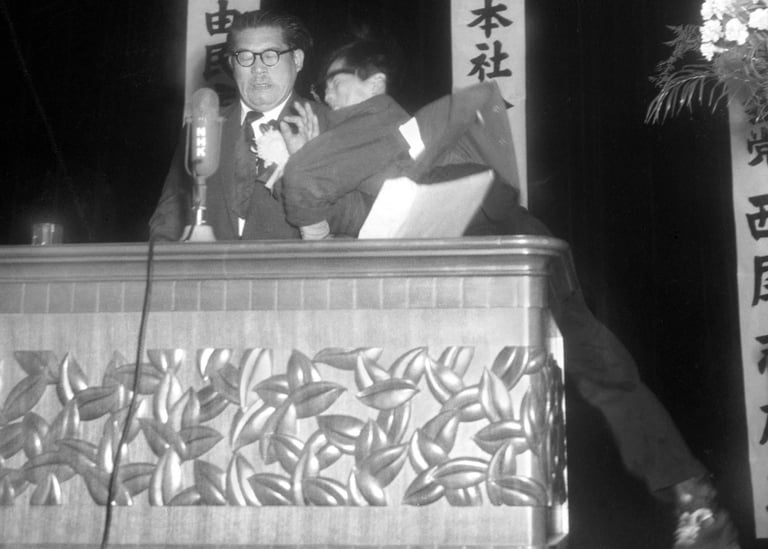
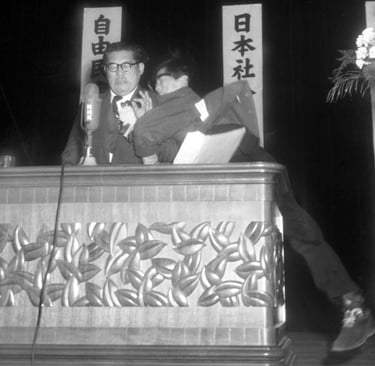
On October 12, 1960, during a televised political debate in Tokyo, Asanuma was speaking before a large audience when Yamaguchi rushed the stage and stabbed Asanuma on the side of his abdomen and through his ribs on the left side. witnesses state that he was in excruciating pain while convulsing, some say that blood and stomach acid squirted out of him.
The autopsy confirmed the following specifics regarding the injury:
Aorta Puncture: The deep thrust of the blade punctured his aorta, the body's main artery.
Internal Bleeding: This led to massive and rapid internal hemorrhaging. Because the bleeding was internal, initial observers mistakenly believed the wound was not fatal as there was very little external blood visible.
Number of Strikes: While some reports mention a single fatal plunge into his side, others state he was stabbed twice. The famous Pulitzer Prize-winning photograph by Yasushi Nagao actually captures Yamaguchi attempting a second strike while Asanuma is already wounded.
The assassination took place on stage at Hibiya Public Hall in Tokyo during a televised political debate.
The broadcast was interrupted, but the moment had already been seen by hundreds in the hall and later replayed across the country.
The killing of Asanuma in 1960 marked a turning point because it collapsed the distance between ideology and spectacle. Unlike earlier political assassinations, this event was captured in real time and broadcast to the public, transforming it into a national psychological rupture. It was not only a political act—it became a shared visual memory, something witnessed rather than merely reported.
Several witnesses later described the scene not in graphic terms, but in emotional ones. One audience member recalled that the moment felt “unreal,” as if the boundary between public debate and something irreversible had collapsed in seconds. Another described the sudden silence afterward—confusion overtaking the room before anyone fully understood what had happened.
Television technicians and reporters present at the event also described shock and hesitation in the immediate aftermath, with some unsure whether to continue filming or cut transmission. The fact that it occurred in a live political setting amplified its psychological impact across Japan.
In the years that followed, Japan’s political culture shifted away from physical confrontation toward verbal and institutional conflict. But the unease from that era remained, as a reminder that beneath structured democracy lay a history where political belief had once been expressed through violence, instability, and irreversible acts.
Disclaimer:
Some details in this article have been exaggerated or stylized for dramatic and horror-focused purposes, which may include sarcasm and humor for storytelling purposes. This piece is intended strictly for entertainment within the dark, horror-true-crime genre and is NOT meant to mock, disrespect, or diminish the real tragedy of anyone's situation or circumstances. Our deepest condolences remain with the victim's family, friends, and loved ones.
Despair
A dark exploration of societal decay and despair.
Void
+1234567890
© 2025. All rights reserved.
Any comments, business inquiries, ideas, or stories, let us know