
The Chambersburg Murders: A Tragic Tale of Betrayal and Innocence Lost
On the night of November 3, 1998, the peaceful rhythm of life in Chambersburg, Pennsylvania was torn apart by an act so savage it defied comprehension. Michael Singley, a troubled 21-year-old, unleashed a storm of violence upon his own family, ending the life of his cousin Christine Jane Beckner Rohrer and brutally attacking her husband, Travis Michael Rohrer. What began as an ordinary evening dissolved into a nightmare that left an entire community reeling — a grim reminder that sometimes the greatest threat doesn’t come from outside, but from the shadows within one’s own bloodline.
10/14/202510 min read
Introduction to the Chambersburg Murders
On November 3, 1998, the tranquility of Chambersburg, Pennsylvania, was shattered when 21-year-old Michael Singley committed a heinous act against his own family. This shocking event, which involved the brutal murder of his cousin, Christine Jane Beckner Rohrer, and the violent attack on her husband, Travis Michael Rohrer, brought forth a dark chapter in the town's history. The tragedy forced the community to confront the fact that violence can erupt in the most unsuspecting places, and that evil often lurks closer than we realize.
The horror that unfolded in an intimate home setting revealed the complexities of human nature. Christine, age 23, had been a beacon of light in her family, full of promise and hope. The tragedy was not only a loss of life but marked the death of innocence for those who knew her.
Singley’s act of violence was not an isolated incident but rather a culmination of underlying issues—depression, familial strife, and obsession. This juxtaposition of familial love and brutal betrayal serves as a reminder that darkness often hides beneath the surface, waiting for the right moment to emerge. The emotions surrounding the attack were not just confined to the immediate family but rippled through the community, leaving many grappling with disbelief and sorrow.
The Chambersburg Dusk
A 66meta6ick Narrative
Some nights never end. Some nights drag their weight across generations, their shadows stitched into the walls of a small town. November 3rd, 1998, was one of them. The air over Chambersburg, Pennsylvania, hung like wet cloth—heavy, unmoving, suffocating. Somewhere on a quiet street, the line between man and monster blurred in silence.
Michael Singley, twenty-one years old, had long since made peace with the voice inside him—the one that whispered of failure, resentment, and the warmth that only destruction could offer. He was a product of isolation, the sort of loneliness that eats through bone. Depression had stripped his empathy bare. Somewhere between prayer and madness, he decided that blood would make sense of his confusion.
Christine Rohrer was his cousin, twenty-three, married, full of the kind of light people remember years after they’re gone. She and her husband, Travis, had built something gentle in a world that often wasn’t. They didn’t know that Michael had been watching them for weeks, that every visit, every small kindness she showed him, fed the sickness crawling in his mind. To him, she was purity. And purity, he thought, was meant to be destroyed.
That morning, he bought his tools—three rolls of duct tape, a folding knife, a box of ammunition, and gloves. Things that could have belonged to a hunter. And in a way, they did.
By nightfall, he parked outside their house, his pulse thrumming like static. Christine had just returned from running errands; the porch light cut her silhouette in gold. Michael approached her with the calm of a man who had already accepted his fate. “Car trouble,” he lied. A simple line, one that opened the door wide enough for evil to enter.
Once inside, the walls became witnesses. The struggle was short but savage. The duct tape muffled her screams, the violence mechanical, unrelenting. Somewhere in the blur of movement, humanity dissolved. When it was over, silence returned—thick, unnatural. Her body lay still, her blood cooling fast in the air that smelled of iron and dust. She tried to fight him off, scream, do everything she could, but he was too powerful, grabbing her by the neck and slamming her against the wall, hitting and later assaulting her so viciously, so vile that her life must have flashed before her eyes. He then threw her on the bed, tied her using duct tape, and raping her again. After this sick fuck finished, he slashed her deep in the front of her body before slitting her throat ear to ear.
Travis came home minutes later. He noticed the stillness first—the half-open door, the faint hum of the television. Then, the sound. A movement upstairs. He called out his wife’s name. Michael was waiting. What followed wasn’t a fight—it was a desperate, animal clash of survival. The report of a revolver cracked through the house. Travis fell, bullets ripping through him like paper, blood pouring, intestines ruptured, Travis left bleeding, dazed, and gagging on his blood, but alive. He saw the face of his attacker before everything dimmed: his cousin, eyes glassy and unrecognizable.
Michael fled into the night, barefoot and shaking, carrying the weight of what he’d done like a relic. He tried to vanish into the dark, but the dark had already claimed him long ago.
The police arrived at a scene that would haunt them for decades. The smell hit first—a mixture of blood and fear, thick enough to taste. The living room light flickered over chaos: overturned furniture, a woman bound and broken, the quiet hum of something evil having passed through. Upstairs, Travis clung to life, pale, trembling, whispering a single name.
It didn’t take long to find Michael. His clothes were still soaked when they arrested him. He spoke in fragments—about voices, about sin, about how death was the only honest thing left in the world. But beneath his ramblings was something colder: satisfaction. The kind that doesn’t come from rage, but from completion.
At trial, the courtroom was silent as the details unfolded. Christine’s family sat motionless as photographs were shown—scenes no one should ever have to see. Michael stared blankly ahead, as if he were watching someone else’s story play out. The jury didn’t need long. The sentence: death.
But death felt too clean for what had happened. Chambersburg would never fully wash it away. For years, people avoided the house. Some swore they could still see light flickering inside, hear faint footsteps when the wind turned right. Others said Michael’s ghost didn’t linger there—it stayed inside those who remembered.
The tragedy of the Rohrers wasn’t just in their death. It was in how easily love and trust were betrayed by the one they had welcomed. How madness wears the mask of family until it decides not to.
Christine’s mother once said that forgiveness was impossible. Not because she hated him, but because what he took wasn’t just her daughter—it was the illusion that safety could exist at all.
There’s a line that separates grief from horror, and in that quiet Pennsylvania town, it was crossed the moment Michael Singley decided to silence his own pain with another’s blood. He was executed years later, though many believed he had already been gone long before that night.
And still, when November returns, and the air grows cold and brittle, some swear you can hear it—the echo of duct tape tearing, a single gunshot, and the faint sound of footsteps leaving a house that would never feel like home again.
CHAMBERSBURG, PENNSYLVANIA — NOVEMBER 3, 1998.
The small, quiet town of Chambersburg was thrust into the heart of unspeakable violence when 21-year-old Michael Singley brutally murdered his cousin, Christine Jane Beckner Rohrer, 23, and attacked her husband, Travis Michael Rohrer, in their own home.
It was a crime that tore apart not just a family, but the illusion that evil was something distant — something that belonged to the cities or the headlines. On that cold autumn evening, horror took root in a Pennsylvania suburb, fed by depression, obsession, and the darker nature of human desire.
The Day of the Crime
The morning began as any other. Christine and Travis Rohrer were an ordinary young couple — newly married, hopeful, deeply rooted in faith and family. Christine was known for her warmth and gentle nature; Travis was the quiet, hardworking type who kept to himself.
Unbeknownst to them, Michael Singley had been unraveling. Friends described him as a withdrawn man battling “some sort of darkness” — a quiet depression that had been eating at him for years. In the weeks leading up to the murder, he withdrew from work and friends, began purchasing supplies, and filled notebook pages with obsessive writings about “purity,” “sin,” and “sacrifice.”
On November 3, 1998, Singley purchased three rolls of duct tape, ammunition for a .44 Magnum, gloves, and a hunting knife. Investigators later discovered receipts timestamped just hours before the killings.
That afternoon, he drove to Christine’s home under the pretense of needing help with a broken-down car. She invited him inside. It was the last act of kindness she would ever give.
The Attack
Police later reconstructed the events based on forensic evidence and Travis’s testimony. Once inside, Michael subdued Christine, bound her with duct tape, and attacked her.
By the time Travis returned home from work, the scene was one of chaos and blood. He entered the house to find his wife unresponsive and Michael waiting in the hallway. A violent struggle followed. Travis was shot and stabbed but managed to escape long enough to alert neighbors, who called 911.
Authorities arrived to find Christine dead, and Michael fled into the night. The calm of the neighborhood had shattered.
In the hours that followed, police launched one of the largest manhunts in Chambersburg’s history. Singley shot a neighbor who tried to stop him before disappearing. He was captured later that evening, sitting in his car just miles from the scene, covered in blood and speaking incoherently.
The Aftermath
The case gripped Pennsylvania for years. Michael Singley was charged with first-degree murder, rape, attempted homicide, and multiple counts of assault. Evidence from his home revealed what prosecutors described as “a deeply disturbed obsession” with his cousin. Bloodstained clothing, handwritten notes, and sketches of Christine were found hidden in his dresser drawers.
During his trial, Singley showed little emotion. He appeared disconnected, almost numb, as witnesses described the brutality of his crimes. Psychologists testified that he suffered from major depressive disorder compounded by obsessive-compulsive and psychotic tendencies.
Still, prosecutors argued the act was deliberate — premeditated in chilling detail.
In 2005, Michael Singley was sentenced to death. He remains one of the most infamous convicted murderers from Franklin County, Pennsylvania.
A Town Left Haunted
For the people of Chambersburg, the case remains a scar. The Rohrer home was eventually torn down; the property stood empty for years. Some residents claimed they could still hear echoes — faint knocks, footsteps, a whisper that seemed to linger in the walls of memory.
Christine’s family never fully recovered. Friends described her as “pure-hearted,” someone who loved freely and trusted easily. Her death, they said, symbolized more than just tragedy — it was the loss of innocence in a place that had believed itself safe.
Travis, who survived, lived under the weight of trauma. He testified in court, helping to convict the man who had destroyed his life. But those close to him said he never truly came back from that night.
The Psychology of the Sin
What makes a man like Michael Singley?
That question has haunted psychologists, preachers, and townsfolk alike.
His crime was not just an act of murder — it was an act of desecration. It violated blood, family, and the sacred boundary between love and lust. Theologians would call it the sin of the flesh — lust unrestrained until it consumes not only the body but the soul.
In his journals, Singley wrote about the body as “a prison of temptation.” He saw Christine as an emblem of purity — a mirror that reflected everything he hated in himself. To destroy her was to destroy his own torment, a perverse logic that speaks to the most frightening part of human depravity: the belief that sin can be cleansed by sin.
Lust and depression, when twisted together, often form something catastrophic. Clinical psychologists note that when self-hatred fuses with desire, it can create a destructive loop — an internal war between guilt and craving, morality and madness.
For Michael Singley, that war ended in blood.
The Warning Beneath the Horror
In the years since, the Chambersburg murders have been studied not only as a case of domestic violence but as a psychological case study in obsessive fixation.
Experts say the tragedy exposes how untreated mental illness, isolation, and unaddressed shame can spiral into violence. The signs were there: erratic behavior, social withdrawal, fixation on a family member, and growing hostility toward religion and intimacy.
But no one saw the pattern clearly until it was too late.
There’s a darker message buried beneath the court documents and newspaper headlines — that evil doesn’t always appear as a monster in the dark. Sometimes it’s the quiet cousin at the family table. The one who smiles too softly. The one whose silence feels heavy.
The Legacy of Christine Rohrer
Christine Jane Beckner Rohrer’s name has since become a symbol in local memorials — not of victimhood, but of the enduring fragility of trust. Her death stands as a reminder of how easily kindness can be mistaken for invitation in the eyes of the unwell.
She was, by all accounts, gentle. She loved to garden, volunteer at her church, and host dinners for friends. Her life was not meant to end in fear. Yet her death has forced others to speak openly about what they once ignored — the silent suffering of those trapped between mental illness and moral collapse.
The Sin That Spreads
Beyond the courtroom, beyond the headlines, the story of Michael Singley reflects a larger truth — that lust, when left unchecked by conscience, becomes a disease. The “sin of the flesh” is not simply sexual; it’s spiritual decay, the consuming hunger to dominate and destroy.
Singley’s crime was not born in one moment of madness. It grew slowly, like mold beneath the wallpaper of his soul. Depression became an obsession. Obsession became desire. Desire became annihilation.
And even now, decades later, the town of Chambersburg whispers his name only in hushed tones, as though saying it aloud might summon something.
Because perhaps the real horror of the case is not what happened in that house, but the terrifying thought that it could happen anywhere, that within any quiet, lonely heart, the same darkness might be waiting for a reason to wake.
....Wanna know more about this case?
Disclaimer:
Some details in this article have been exaggerated or stylized for dramatic and horror-focused storytelling purposes. This piece is intended strictly for entertainment within the dark, horror-true-crime genre and is NOT meant to mock, disrespect, or diminish the real tragedy of anyone's situation or circumstances. Our deepest condolences remain with the victim's family, friends, and loved ones.





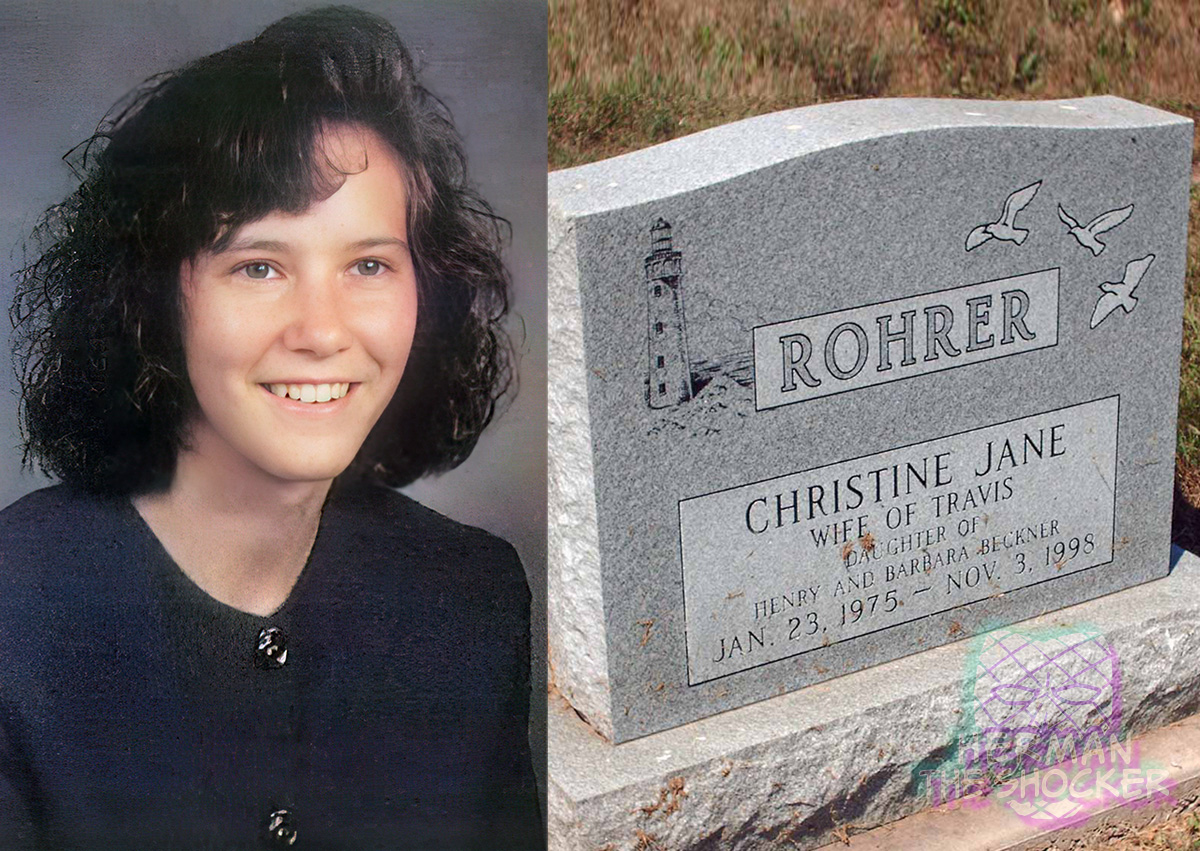
Jane Beckner Rohrer
The house where the murder took place



A Picture of the Monster, Michael Singley
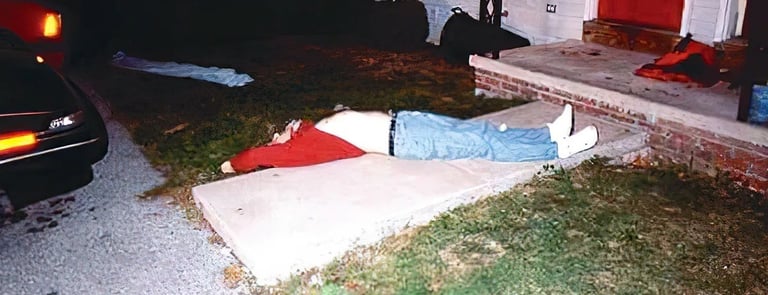
Injured Travis Michael Rohrer
Christine’s death at 23 remains a grim reminder of how ignored mental illness can turn tragedy into horror — a call for awareness before despair becomes destruction.
Despair
A dark exploration of societal decay and despair.
Void
+1234567890
© 2025. All rights reserved.
Any comments, business inquiries, ideas, or stories, let us know