
One Jump Too Far: The Final Descent of Sergey Bezruchenok
Sergey Bezruchenok was an experienced skydiver who had completed 499 successful jumps before traveling to Russia for what was meant to be a milestone descent. On July 26, 2019, at Krutitsy Airfield near Ryazan, a routine jump turned tragic when his parachute system malfunctioned during the final phase of descent. Despite attempts to regain control, he was unable to recover before impact. He later died from severe injuries sustained in the accident. This article explores his life, discipline, final jump, and the chilling reality of how quickly experience can be undone by physics, timing, and chance in extreme sports.
DISTURBING CASESGRIM REALITYNSFWOUR DREADFUL WORLD
4/8/20264 min read
The 500th Jump: Sergey Bezruchenok’s Final Descent into the Trees
Sergey Bezruchenok was never the type to stand still. Born in Belarus, he spent nearly a decade building a life far from home in the United Arab Emirates, where he worked as a marketer in the fast-moving world of IT and consumer electronics. By day, he shaped campaigns and product strategies. Outside of work, he chased something more visceral.
Extreme sports were not hobbies to Sergey—they were proof of life. He had already tested himself through freediving, enduring silence, and pressure that most people could not imagine. But skydiving became his defining pursuit. Each jump was a controlled risk, a practiced negotiation with gravity. By the summer of 2019, he had completed 499 successful descents.
The 500th was meant to be a milestone.
He traveled to Russia for it, choosing Krutitsy Airfield near Ryazan. On July 26, conditions were favorable—clear skies, manageable wind. It was the kind of day experienced jumpers trust.
Sergey prepared as he always had. Equipment checked. Helmet camera recording. Focus steady.
The plane climbed. The cabin settled into quiet anticipation. And when the moment came, he stepped into open air.
Weightless — Then Failure
The freefall began normally—stable, controlled, familiar. His parachute deployed correctly, slowing his descent into a glide. For a brief moment, everything aligned.
Then something changed.
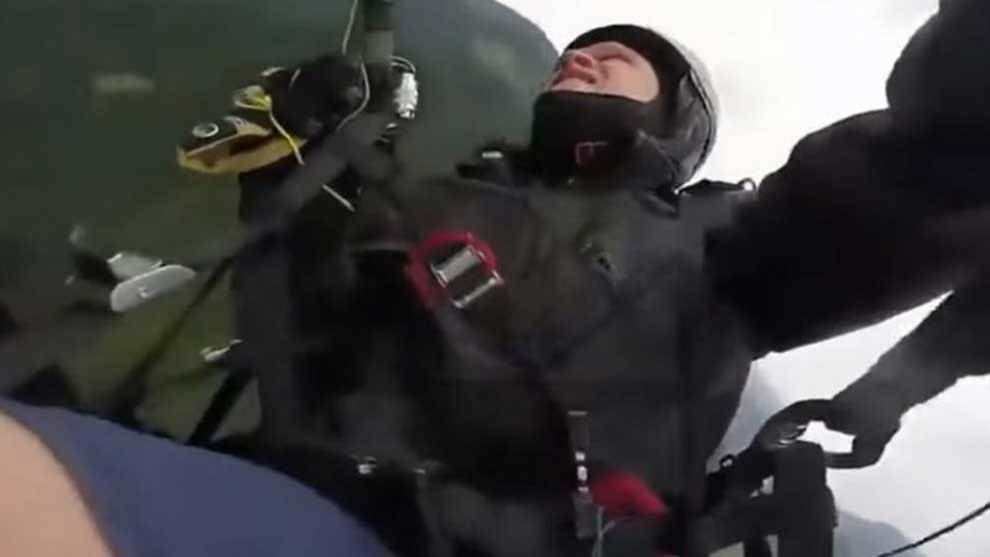
During the final phase of descent, the suspension lines twisted. The canopy, once stable, began to lose structure and spin. At low altitude, time becomes the most limited resource—and there was very little left.
Sergey attempted to correct the malfunction. The footage later showed him actively trying to regain control, his movements urgent but constrained by the failing canopy. The reserve parachute was not deployed in time.
He descended into a wooded area near the airfield.
Emergency responders reached him and transported him first to a hospital in Shilovo, then to a regional facility in Ryazan. He suffered severe traumatic injuries, including critical head trauma and multiple fractures. He remained in critical condition for two weeks as doctors attempted to stabilize him.
On August 11, 2019, Sergey Bezruchenok was pronounced dead.
The Moment Control Disappeared
It didn’t feel like a disaster at first.
It felt like a mistake—something small, something fixable. That’s what makes these moments so unbearable in hindsight. Nothing announces itself as the ending while it’s happening. There’s no warning siren in the sky, no visible line where safety stops, and consequences begin.
Just a quiet shift.
The canopy that once felt steady began to behave like something unfamiliar—no longer an extension of skill, but a failing system reacting on its own terms. Every correction Sergey made was met with resistance, like the air itself had stopped cooperating.
This is the part no one prepares for: the realization that experience doesn’t stop physics. That thousands of successful jumps don’t negotiate with seconds that are disappearing too fast to count.
He paused for one moment, thinking it was just a gust of wind. A little bit after in the video, he started spiraling, struggling with the parachute strings as if he was the marionettist in control, unfortunately he was wrong, dead wrong in an instant, you can hear his cries for help as he struggled with properly opening the parachute until smacking to on the ground, causing multiple injuries including internal bleeding within him most of his bones were crushed and his internal bleeding in his head, caused by the impat of his brain smaking agiest the ground even causing his skull to crack and he felt everything, but while he did surivied the inial impact he later died in a coma due to his very serviere injuries.
Panic doesn’t always arrive loudly. Sometimes it arrives as focus—too much focus, narrowing into a single thought: fix it, fix it, fix it—while the world continues moving forward without waiting for permission.
And beneath it all is the most disturbing truth of extreme sport: there is a point where control doesn’t fail suddenly… it simply stops being yours.
The Video That Circulated
Sergey’s helmet camera recorded the entire jump—from exit to malfunction. The footage later spread online, drawing attention for its unfiltered documentation of a fatal skydiving accident.
It did not gain attention for spectacle alone, but for what it revealed: how quickly a controlled descent can become uncontrollable. Within seconds, a routine jump turned into a situation with no margin for recovery.
The Silence After the Fall
Sergey was not inexperienced or careless. By all accounts, he was methodical and disciplined. His death became a reminder of a fundamental truth in extreme sports: risk can be managed, but never eliminated.
Krutitsy Airfield still operates. Aircraft still climb. Jumpers still step into the open sky.
But incidents like this remain as quiet warnings.
The sky does not recognize milestones. It does not measure experience or reward consistency. A single malfunction, a moment of lost control, and even a 500th jump can end the same way as a first.
And near Ryazan, the forest still stands—unchanged, indifferent—marking the place where a milestone was never completed.
Disclaimer:
Some details in this article have been exaggerated or stylized for dramatic and horror-focused purposes, which may include sarcasm and humor for storytelling purposes. This piece is intended strictly for entertainment within the dark, horror-true-crime genre and is NOT meant to mock, disrespect, or diminish the real tragedy of anyone's situation or circumstances. Our deepest condolences remain with the victim's family, friends, and loved ones.
Despair
A dark exploration of societal decay and despair.
Void
+1234567890
© 2025. All rights reserved.
Any comments, business inquiries, ideas, or stories, let us know